Introduction
As you venture into the medical laboratory domain, one question that pops up in the minds of many future professionals is — what’s the difference between MLS vs MLT? Although both occupations are essential in diagnosing patients and performing laboratory tests, the differences in qualifications, duties, and possible career development can have a major impact on your journey through the world of work.
By knowing the difference between MLS vs MLT, you will be able to select the most suitable training course, get ready for the certification process, and have a good idea about the expected salary and career progression. Whether you’re a Medical Laboratory Technician (MLT) just starting in the profession or you want to move to the next career level as a Medical Laboratory Scientist (MLS), this comparison will give you a clear picture of the healthcare career path associated with the similarities and differences of these roles.
Looking to explore opportunities in allied health? Browse Allied Health Jobs (https://alliedhealthjobs.us/) and start your journey today!
Education & Certifications: The Foundation of MLS vs MLT
The first major difference between MLS vs MLT is their educational qualifications and certification requirements.
Medical Laboratory Technician (MLT)

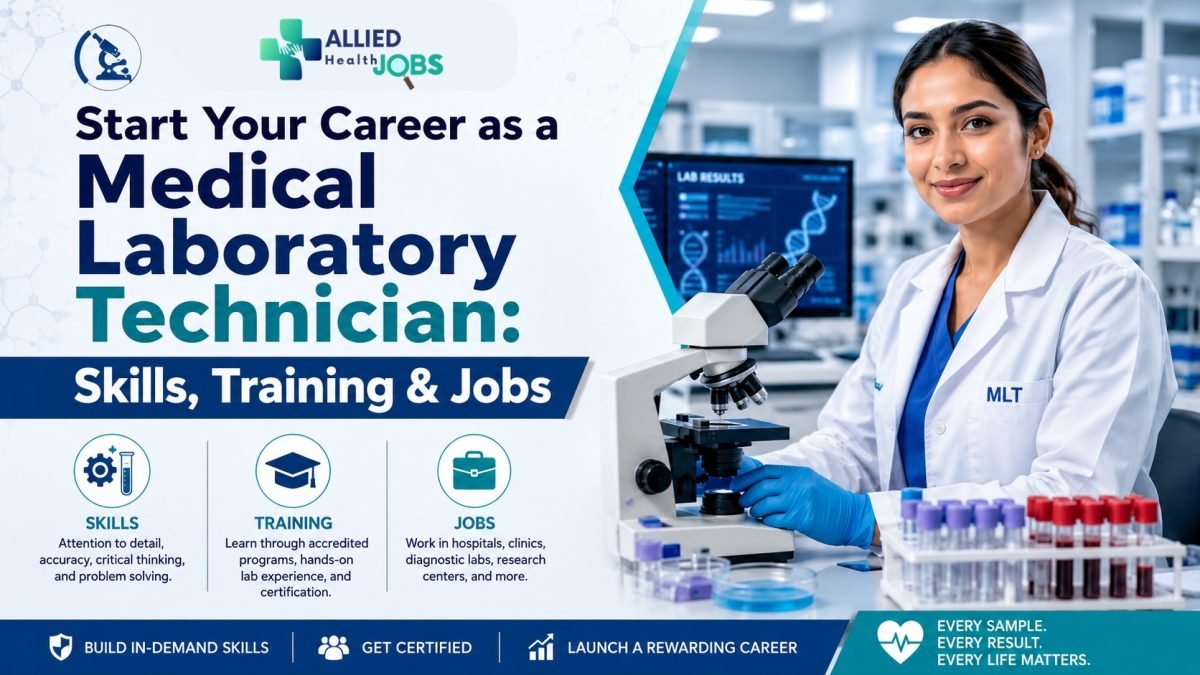
An MLT usually receives education from a two-year associate degree program at an accredited college or university. Concentration in these programs is on basic laboratory activities like collecting samples, carrying out tests, and following laboratory rules. Students get hands-on instruction in hospitals and clinics and are taught how to use and care for the tools in the laboratory.
Once the program is finished, graduates may apply to take a certification examination from any of the following organizations, among others:
- The American Society for Clinical Pathology (ASCP) Board of Certification (BOC)
- The American Medical Technologists (AMT) certification organization
When you obtain a certification such as MLT(ASCP), it is a confirmation of your skills, and it could also be a factor that increases your chances of getting hired and the salary offered to you.
Medical Laboratory Scientist (MLS)

An MLS, otherwise known as a Clinical Laboratory Scientist (CLS), possesses at least a bachelor’s degree in medical laboratory science or one of its allied fields, such as biology or chemistry.
The MLS programmes comprise intricate studies in clinical chemistry, hematology, microbiology, molecular diagnostics, and immunology. Besides the theoretical studies, students in MLS courses rotate in hospitals or diagnostic laboratories under trained supervision.
The candidates are required to clear a national certification exam, for instance, MLS(ASCP) or CLS(NCA), in order to be considered for employment after graduation.
In short:
| Role | Education Level | Certification | Duration |
| MLT | Associate Degree | MLT(ASCP), AMT | ~2 years |
| MLS | Bachelor’s Degree | MLS(ASCP), CLS(NCA) | ~4 years |
Scope of Practice: Daily Roles and Responsibilities
The difference between MLS vs MLT also lies in the extent of their daily job functions and the level of independence allotted to them in the laboratory.
MLT Responsibilities
It is the responsibility of the Medical Laboratory Technicians to mainly handle the routine and standardized laboratory tests. They carry out the preparation of specimens, operating automated analyzers, and recording results under live supervision by either an MLS or a laboratory manager. The MLTs are vital for the assurance of sample accuracy as well as the continuity of quality control procedures.
Everyday activities may include:
- Doing blood and urine tests
- Using lab instruments and analyzers
- Producing reagents and solutions
- Doing data entry and reporting results
MLS Responsibilities
Medical Laboratory Scientists, in contrast, take more complicated testing, analysis, and interpretation as their responsibility. They are often dealing with sophisticated diagnostic procedures, overcoming problems with abnormal results, and making sure that regulations are followed.
Their job consists of:
- Inventing and validating test methods
- Advanced diagnostic tests (like molecular assays and blood banking) are carried out in the laboratory with the help of MLTs and lab assistants.
- MLTs and lab assistants are supervised by the MLS.
- New lab staff are trained, and lab safety standards are assured.
In numerous cases, the MLS serves as a connector between lab techs and pathologists, thus preserving the correctness and reliability of the diagnostic data provided to the clients.
Salary & Job Demand: MLS vs MLT in Today’s Market
Salary and job outlook are considerable factors when comparing the two careers— MLS vs MLT. Both professionals are highly sought after in hospitals, research facilities, diagnostic labs, and health departments.
Salary Comparison
Based on the national averages, which are projected for the year 2025:
- The range of Medical Laboratory Technician (MLT) salaries is usually from $48,000 to $62,000 a year, depending on the employee’s experience and the place he/she live.
- On the contrary, Medical Laboratory Scientists (MLS) personnel expect and receive higher pay due to their greater qualifications and roles, ranging from $65,000 to $85,000, with top-level MLS positions in specialized labs or management exceeding $90,000.
The following factors have an impact on salary:
- Living area and the state of the housing market.
- Healthcare facility type (which can be a hospital, a private lab, or a government agency).
- Professional certification and training.
- Shift differentials and night working.
Job Outlook
The U.S. Bureau of Labor Statistics (BLS) has predicted that job growth for both MLS vs MLT roles will be faster than the average job growth in other areas, which is due to the aging population as well as the rising demand for diagnostic testing technologies.
MLS professionals have been the most sought after in molecular diagnostics, biotechnology, and clinical research because of the necessity of accuracy for testing and accuracy in interpreting:
If you are interested in the current job openings, take a browse at the most recent medical laboratory jobs listed on Allied Health Jobs.
Career Ladder: Progressing from MLS vs MLT
The majority of lab professionals start as MLTs and then go up the ladder to get the MLS title. With this transition comes more duties, higher wages, and more professional recognition.
A Step-by-Step Career Path
Join as an MLT
Acquire essential skills and knowledge in laboratory tests, firstly through practical work in the lab and by learning the workflow, and then by gaining an understanding of quality control.
Seek Higher Education
While employed, get a bachelor’s degree in medical laboratory science or a similar area. Besides, many universities provide bridge programs (MLT-to-MLS) that are suitable for working people.
Get Certified
As soon as you complete the necessary degree, you can apply for MLS(ASCP) certification or the equivalent.
Promotion to Management or Expert Roles
With some years of experience, an MLS professional can advance to senior positions like laboratory manager, quality assurance officer, clinical educator, or research specialist.
This career ladder provides constant professional development — a feature of the allied health sector — and guarantees that laboratory professionals can keep pace with the latest medical technologies.
Conclusion: Deciding Between MLS vs MLT
Saying it simply, the difference between MLS vs MLT, is in the amount of education, duties, and the potential for growth over time. An MLT position is perfect for people who want to start working in the healthcare sector quickly and learn about the diagnostics process hands-on. At the same time, an MLS position is for those who are striving for advanced roles, supervisor positions, or special lab work.
The two ways in which one can travel are both very rewarding careers, with a continuous demand for jobs, and making a meaningful input in patient care. Regardless of the fact that you are initially an MLT or you have the intention to rise to the level of an MLS, the allied health sector is gradually increasing, with a lot of places to grow.
In case you are open to new job positions, then head over to Allied Health Jobs — your reliable ally for the phlebotomy career growth, phlebotomy job opportunities, and other allied health sectors.
Follow us on Social Media: LinkedIn | Facebook | Twitter | Instagram